

She was told that being a good mom meant being gentle—that she should understand her child’s emotions, embrace every tantrum, and respond with warmth even when her body and mind were on the verge of collapse.
But no one ever asked her:
Did she still have the strength to be gentle?
Was there anyone behind her, quietly holding together the pieces of a chaotic day?
She wanted to be that patient, emotionally available mother.
But she was tired—deeply, overwhelmingly tired.
Living in a cross-cultural family only intensified the pressure.
She tried to embody Western ideals of respecting a child’s autonomy, while also carrying the traditional Eastern belief that mothers should be endlessly capable and self-sacrificing.
She studied “gentle parenting,” tried to model emotional regulation—but most days, she couldn’t even find time to drink a warm cup of tea.
Her gentleness was never the result of perfection.
It was the result of necessity.
Of survival.
What she truly longed for was gentleness in return—not from her child, but from her partner.
She didn’t want him to be perfect.
She just wanted him to see her.
To notice when she was unraveling.
To understand that when she was down on the floor soothing their child, what she really needed was someone behind her wiping up the spilled cereal.
That when her patience was fraying, she was hoping he would come and say:
“Take a break. I’ve got this.”
She didn’t want to manage him or teach him how to help.
She wanted a teammate.
A witness.
Someone to pick up where she left off when she had nothing left to give.
She still wanted to be that gentle mom.
But she wished someone would understand that gentleness shouldn’t come at the cost of self-erasure.
Every time she held it together, she silently hoped someone else would help hold her.
Not as an assistant.
Not as a guest parent.
But as a man who understood that love often looks like doing the dishes without being asked.
Like taking the child for a walk so she could cry in peace.
Like stepping in—not for praise, but because it’s his family, too.
**
This wasn’t resentment.
It was a quiet, desperate kind of hope.
She didn’t need grand gestures.
She needed presence.
She didn’t need to be rescued.
She needed to not be left alone.
Because the most profound kind of love, in the end, is not about flowers or celebrations.
It’s about someone saying:
“You’ve done enough today.
Let me take care of the rest.”
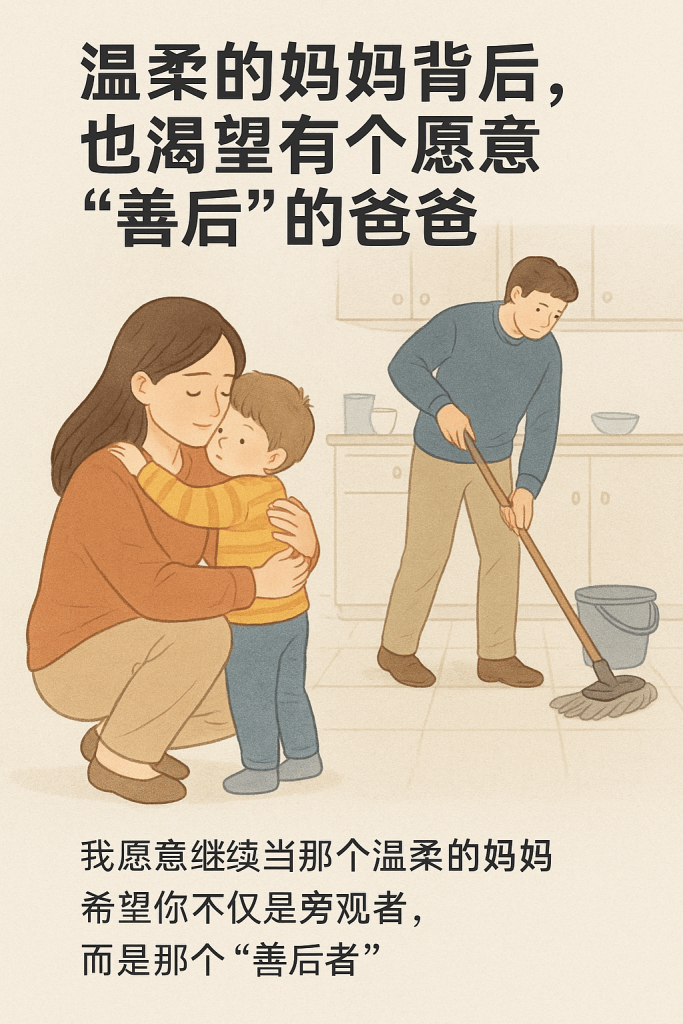
温柔的妈妈背后,也渴望有个愿意“善后”的爸爸
成为妈妈之后,我常常被要求“温柔”,要理解孩子的情绪、接纳他们的哭闹、在崩溃的时刻还能轻声细语地回应一句“妈妈在这”。
但没有人问我:我还有力气温柔吗?我身后,是否有人能帮我兜住这一地鸡毛的现实?
我多希望,在我蹲下来安慰孩子的时候,背后有人默默地收拾那摊被打翻的麦片;
在我情绪濒临崩溃的时候,有人对我说:“你先去休息一下,我来。”
我不是不想温柔,而是我太累了。
在跨文化的家庭里,这种疲惫尤其明显。
我努力理解德国社会强调“尊重孩子意愿”的做法,同时又背负着中国传统对母亲无所不能的期待;
我学习如何与孩子“平等沟通”,却常常连一口热茶都喝不上;
我想成为那种情绪稳定的“gentle parent”,但没人接住我的情绪。
于是我想问爸爸:你能不能也来学一学“温柔”这门功课?不是对孩子,而是对我。
当我半夜哄孩子哄得眼神涣散时,你能不能起身帮我倒杯水?
当我在厨房一边煮饭一边吼人时,你能不能站过来替我把锅铲接过去?
当我为了早教预约、疫苗本、园艺活动绞尽脑汁时,你能不能帮我确认一下时间?
我不是想“指挥你”,我只是太想,有个人和我并肩,而不是在我快垮的时候,提醒我“别太情绪化”。
我愿意继续当那个温柔的妈妈,只是这温柔,不该是牺牲自我的代价。
我希望你也能看到,那些我咬牙硬撑的背后,其实是无数次希望你来接力的等待。
**
这不是埋怨,而是一个妻子、一个妈妈、一个女人,最真诚的期待。
希望你不是孩子的“临时演员”,而是我们家庭的稳定支柱;
希望你不是在看我育儿,而是和我一起育儿;
希望你不是旁观者,而是那个“善后者”——不为掌声,只为我们这个家。
当你愿意出手分担,我也会有力气继续温柔下去。
而这世界上,一个妈妈最需要的浪漫,不是鲜花和节日礼物,而是有人在她撑不住的时候,替她收拾残局,说一句:“我来。”
 Mademoiselle
Leave a comment