
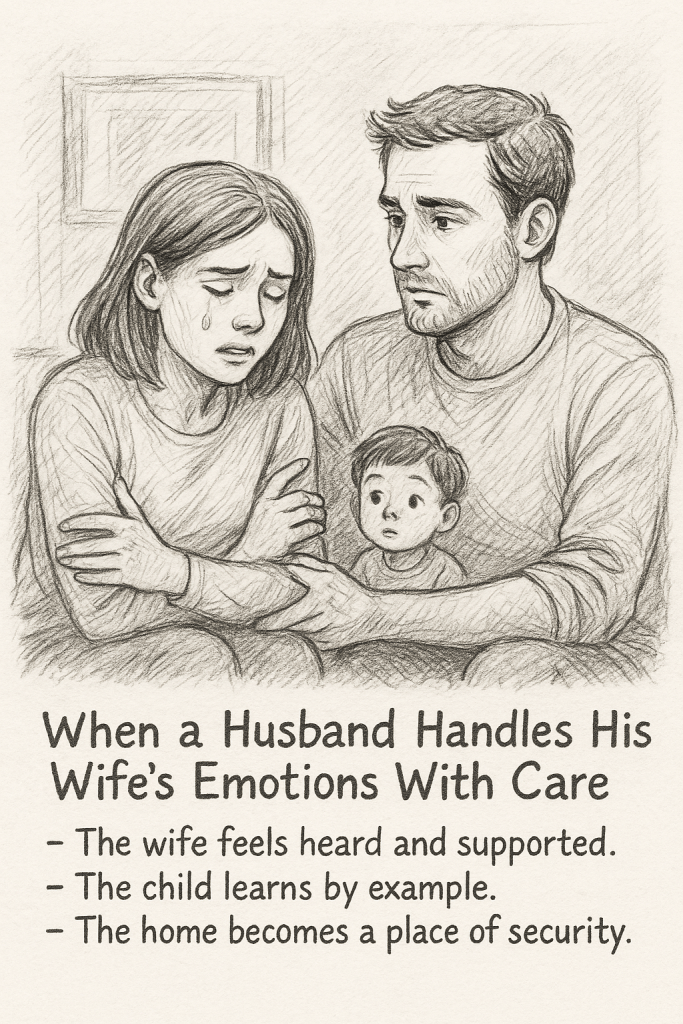
In every family, emotions don’t just sit still—they move, echo, and ripple. They rise in one person and quietly fall on another. And within the quiet corners of a home, the way a husband handles his wife’s emotions can shape the emotional climate not just for her, but for their children too.
The Power of Emotional Support
A woman doesn’t always need her husband to “fix” her problems. But she deeply needs to feel heard, seen, and held emotionally. A supportive husband helps co-regulate, not dominate. He listens without defensiveness. He tries to understand the why behind her pain instead of rushing to dismiss it. When a man becomes a safe emotional space for his wife, it builds trust, intimacy, and strength in the marriage.
Children watch these interactions more closely than we think. When they see their father handle conflict with empathy—when they see him softening instead of shutting down—they learn how to relate, how to respect, and how to love.
When the Husband Is Emotionally Absent
But what happens when a husband becomes self-centered? When he never lets go of past conflicts and clings to emotional grudges like armor?
In such a dynamic, the wife becomes emotionally isolated. Her needs go unheard. Her sadness becomes invisible. And instead of a partner, she finds herself facing life as a lone fighter, while the person she hoped would hold her hand becomes the one she must constantly defend herself against.
The Impact on the Child
Children are extremely sensitive to emotional undercurrents. When the father is emotionally absent or hostile, the child:
Feels insecurity: When one parent is always emotionally distant or angry, the child may feel that love is unpredictable or conditional. Learns imbalance: The child may internalize the idea that one partner should always be silent and giving, while the other gets to take, blame, and control.
Mirrors behavior: If the father never apologizes, never lets go of the past, and treats his wife with coldness, the child may grow up thinking that’s what strength or manhood looks like.
Carries silent guilt: Many children think they are the reason for the sadness between their parents. They may become people-pleasers, or swing to the other end—emotionally shut down to protect themselves.
When the Past Becomes a Prison
Some men hold on to past wounds like it’s their identity. They won’t let go. They revisit old arguments, reopen old wounds, and recycle blame. And in doing so, they slowly erode the present.
But forgiveness isn’t about forgetting—it’s about choosing growth. A husband who cannot move forward emotionally traps the family in a loop of pain and emotional stagnation. Over time, the wife loses hope. And the child begins to live in a house full of invisible tension.
The Choice: Break the Cycle
Marriage isn’t about perfection. It’s about presence. About the willingness to learn, repair, and grow together.
If you’re a husband reading this and you recognize these patterns—pause. Ask yourself:
Do I truly listen to my wife without interrupting or defending? Do I carry resentment that has long expired but still rules my tone? Do I want my child to repeat what they see between us?
Empathy is not weakness. Letting go of the past is not surrendering. It’s freeing your family to move forward.
Because the home you help shape today is the emotional blueprint your child carries for life.
丈夫如何对待妻子的情绪,会深深影响孩子的一生
在每一个家庭中,情绪从不静止不动。它们流动、回响、扩散。一个人的情绪悄悄传递到另一个人身上。而在家庭这个小世界里,丈夫如何回应妻子的情绪,不仅影响夫妻关系,更会塑造整个家庭的情感氛围,甚至深远地影响孩子的心理成长。
情感支持的力量
妻子并不总是需要丈夫为她“解决问题”。但她非常需要被听见、被理解、被情感地接住。一个有情感支持能力的丈夫,不是试图控制情绪,而是愿意一起面对、共情。他会认真倾听,而不是急着反驳;他会努力理解她的痛点,而不是下意识地否定或回避。
孩子对这些互动的观察,比我们想象得更敏锐。当他们看到父亲温和地处理冲突,愿意倾听母亲的情绪,他们就学会了什么是尊重、共情和健康的亲密关系。
当丈夫情感缺席
但如果丈夫情感上是自我中心的呢?如果他总是纠缠于过去,从不真正放下?
妻子会逐渐变得孤独无助。她的感受得不到回应,悲伤无处倾诉。而她曾经期待成为依靠的那个人,反而成了她要防备的对象。
对孩子的影响
孩子对家庭氛围非常敏感。如果父亲情感冷漠或充满敌意,孩子可能会:
缺乏安全感:当一个家长总是冷漠、情绪不稳定,孩子很难建立稳定的归属感。 习得不平衡关系模式:他们会认为,亲密关系中,一个人付出沉默和忍耐,另一个人则可以理所当然地索取、责备。 模仿父亲的行为:如果父亲从不道歉,总是沉溺于过去、冷落母亲,孩子也可能长大后重复这样的模式。 承受内在的愧疚:很多孩子会把父母之间的冷战或冲突归因于自己,久而久之,形成讨好型人格或完全封闭的情绪保护机制。
当“过去”成为家庭的牢笼
有些丈夫把旧伤口紧紧抓住,仿佛那是他们的“自尊”或“立场”。他们不断翻旧账、重复旧争吵、用过去的错误否定妻子的现在。
但原谅不是遗忘,而是选择成长。如果一个丈夫无法放下过去,他其实是在让整个家庭卡在痛苦的轮回里。妻子会逐渐失望、心冷,而孩子则生活在看不见的紧张和伤害之中。
选择:打破这个循环
婚姻不需要完美,而需要在场。需要愿意学习、修复和一起前进的勇气。
如果你是一位丈夫,读到这里,请停下来问问自己:
我真的有认真听妻子说话吗?我是不是总在打断或辩解? 我是不是还在执着于早已过去的伤害,却用它影响现在的关系? 我希望我的孩子长大后也复制我们之间的这种相处模式吗?
共情不是软弱。放下过去,不是投降,而是为家庭创造前进的空间。
因为你今天为家庭设下的情感基调,就是孩子未来人生的底色。
 Mademoiselle
Leave a comment