A Chinese Mother’s Take on Parenting Across Cultures
Introduction
In Chinese culture, we often say, “I’m doing this for your own good.”
This phrase carries love, but also weight—and sometimes, unspoken control.
But when I became a mother raising a child abroad, I began to notice that in Western parenting, love is expressed differently. Not as protection through obedience, but as respect for choice. This is my journey between “for your good” and “out of love.”
1. “For Your Own Good” Often Means Control; “Out of Love” Means Respect
In traditional Eastern parenting, parents act as decision-makers:
They might say, “You can’t eat spicy food because of your stomach,” or “Don’t play near water—it’s dangerous.” No discussion.
But in Western parenting, the same situation might go like:
“You want to try spicy food? Let’s try a small bite and see how your body reacts.”
Or: “You want to play near water? I’ll be close, just in case, but I trust you.”
Western parents respect autonomy even in young children, trusting they can learn through experience—whereas Eastern parents prefer to shield them from risk.
2. Chinese Parenting: Produces Obedience, Not Always Self-Awareness
Growing up under “for your own good,” many of us learned to follow rather than to reflect.
I remember making choices not because I wanted them, but because they were expected:
Good grades, stable jobs, safe paths. It made me responsible—but also unsure of what I wanted.
Now as a mother, I worry:
If I repeat the same logic, will my child grow up obedient—but emotionally disconnected from himself?
3. Western Parenting: Encourages Emotional Intelligence and Consequences
In my son’s kindergarten, emotional education is central.
Children are taught to say, “I feel angry because…” instead of “I’m a bad kid.”
They face real consequences, not punishments.
Forget your jacket? You feel cold.
Break a toy? You learn to take care next time.
This form of “respectful detachment” fosters responsibility from within, not just compliance from above.
4. Cross-Cultural Parenting: Balancing Boundaries and Love
As a Chinese mother living in the West, I am constantly navigating two cultural maps.
I want to guide my child, but not suffocate him.
I want to protect him, but also let him fall, try, and get up again.
I am learning to love with boundaries, and to step back when needed.
Love is not always stepping in. Sometimes, love is watching quietly, ready to catch—not control.
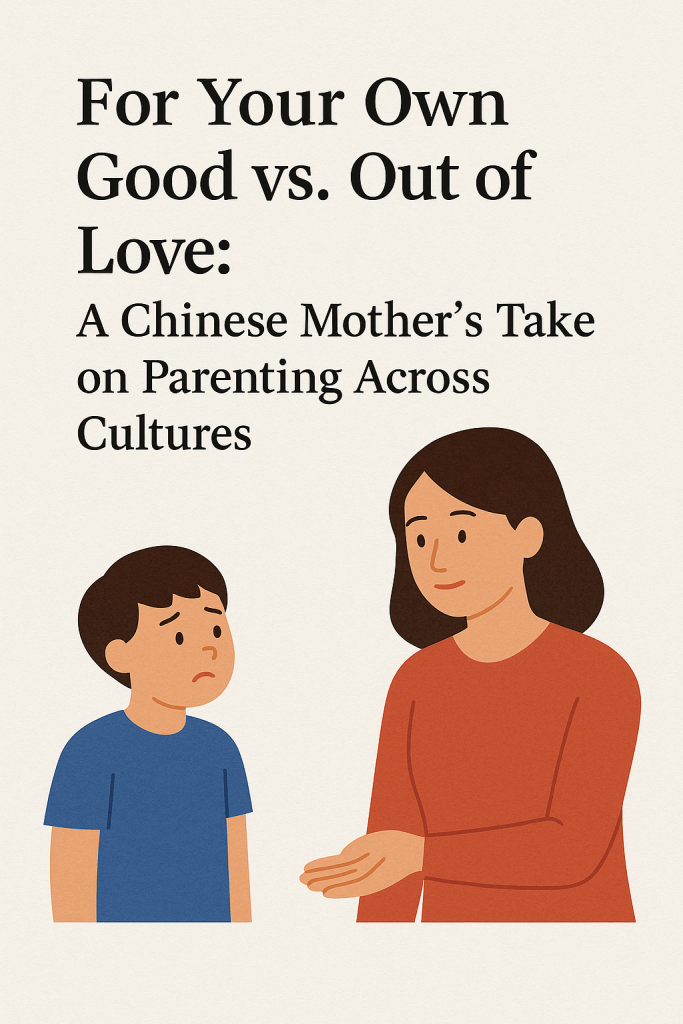
与其“为你好”,不如“对你好”
——一个中国妈妈在中西文化间的育儿体会
“我这是为你好。”
在中国文化中,这句话是太熟悉不过的爱之表达。
在我成长的记忆中,这是一句既温暖又有些沉重的语言:父母用这句话决定了我能不能选文科,能不能晚归,甚至将来能不能出国。他们说,他们的一切安排,都是“为我好”。
可当我成为母亲,尤其是在异国他乡抚养孩子,我渐渐开始反思这句话的分量。在西方文化的育儿环境中,我第一次意识到,“为你好”和“对你好”,其实是两种截然不同的爱。
“为你好”是一种控制,“对你好”是一种尊重
在传统东方家庭中,“为你好”往往与权威和服从挂钩。
长辈经验被认为是无可置疑的,因此孩子不需要“理解”,只需要“听话”。
而在西方文化中,父母更倾向于与孩子“协商”与“尊重个体选择”。他们更重视孩子的主观体验和情绪状态,即使孩子还小,也会被视为一个有感受、有决策权的“完整的人”。
比如:
孩子想吃辣,而身体可能无法承受。东方家长可能会直接制止:“你不能吃,对身体不好。” 而西方家长可能会说:“你想尝吗?我们可以找不太辣的试试,如果感觉不舒服要及时说出来。” 孩子想在水边玩。中国父母第一反应是拉开、警告、甚至呵斥; 而在西方,我常看到父母坐在一旁观察,保持警惕但并不干预,只在孩子真正有危险时才介入。
这种“边界式的陪伴”是我在做母亲后慢慢体会到的。它不是放任,而是放手;不是溺爱,而是信任。
中式育儿的“为你好”:让孩子乖,却不一定让他懂
身为一个中国母亲,我理解“为你好”的出发点:那是一种深沉的责任感和焦虑。
我们害怕孩子吃亏,走弯路,所以总想替他们多想一步,替他们把路铺平。
但我也发现,在这样的“为你好”中,孩子可能学会了服从,却很难发展出真正的自我认知与情绪管理能力。
他们可能会问:“我这么做,是我想要的吗?还是爸妈要我这么做?”
这对于一个在海外成长、需要独立表达自己、融入多元文化的孩子来说,是一大障碍。
西式育儿的“对你好”:让孩子学会选择与承担
在西方学校和家庭教育中,情商(emotional intelligence)被放在非常核心的位置。
老师和家长会鼓励孩子表达情绪,比如用“I feel…”句式来描述自己的感受,而不是用“我乖不乖”、“你有没有听话”来评价行为。
他们也会让孩子从小承担后果,比如:
没收好玩具就真的找不到; 忘记带外套出门就要体会寒冷; 做了不当行为就要道歉、修复。
在这样的教育下,孩子学会了为自己的决定负责,而不是将选择权让渡给“为我好”的大人。
跨文化育儿的挑战:在爱与自由之间找平衡
作为一个中国妈妈,我既带着传统的文化基因,又身处一个强调独立与表达的西方社会。
每天的育儿,都是一场文化内心的对话:
我会担心孩子太任性,却又不愿扼杀他表达自我的能力; 我想保护他不受伤害,却也知道不能替他走完所有的路。
于是,我开始学习一种新的“母爱表达”:
拥有一双“伸出又缩回的手”:在他真正危险时拉他一把,其它时候,放手让他去尝试。
我也在情商教育中不断摸索:
如何不以“听话”衡量好坏,如何陪他识别和表达情绪,如何引导他用“对你好”的方式去爱人、也爱自己。
结语:
真正的“对你好”,不是控制,而是理解、尊重与陪伴。
在中式“为你好”的厚重责任感里,我们学会了奉献与忍耐;
在西式“对你好”的温柔边界里,我们看见了自由与自我。
作为母亲,我希望我能给孩子两种文化中最温暖的那一部分:
既有责任心,也有选择权;
既知道“该做什么”,也知道“我为什么做”。
愿我们都能在这条跨文化的育儿路上,
用一颗柔软而坚定的心,学会对孩子,也对自己,“真正地好”。
 Mademoiselle
Leave a comment