
📝 Cross-Cultural Parenting Notes|Getting Ready for School: Navigating Chinese and German Expectations, and Our Blended Approach
Our child is about to take an important step—starting elementary school.
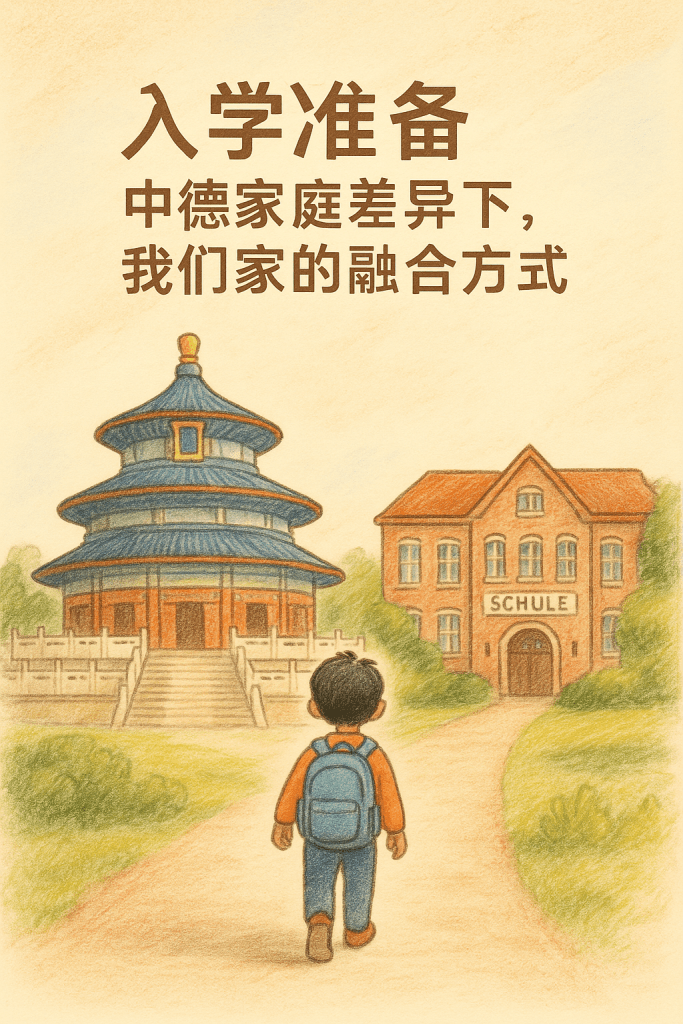
As a Chinese mother living in Germany, this moment fills me with both excitement and unease. More than that, it has become a meaningful exercise in cultural integration for our family.
I’ve come to realize that Chinese and German families have very different expectations and methods when it comes to school readiness. And somewhere between these two cultures, our family has found a way to balance both.
🇨🇳 The Chinese Approach: Academic Basics + Rule Awareness
In China, children are often expected to have a certain academic foundation before starting school:
- Recognizing Chinese characters, writing their names, reciting poems
- Counting and doing simple math
- Understanding classroom discipline and following teacher instructions
- Being able to complete simple tasks independently
Many parents enroll their children in “preschool-to-primary bridging programs,” hoping they won’t “lose at the starting line.” For Chinese parents raised in a highly competitive education system, this kind of early planning is a form of love.
I used to feel anxious too:
Does my child know enough characters?
Can he sit still long enough?
Will he fall behind in school?

🇩🇪 The German Approach: Social Skills + Independence in Daily Life
In Germany, teachers and parents place more emphasis on a child’s overall Schulfähigkeit (school readiness), which includes cognitive development but focuses even more on:
- Emotional self-regulation
- Ability to follow instructions and take turns
- Dressing themselves, packing their school bag Social skills—cooperating peacefully with other children
- Focus and willingness to solve problems
German teachers often say:
“Reading and writing can be learned gradually, but learning to get along with others is a lifelong lesson.”
That sentence deeply resonated with me.
👨👩👦 Parental Involvement: Different Roles in Preparation
In China, parents are highly involved—supervising homework, reading with the child, managing tutoring schedules, even coordinating class group chats.
In Germany, parents are more like supporters and observers. They trust the school system and encourage their children to be independent.
I can understand both approaches. So in our home, we tried to blend the best of both:
Cognitive: We use games to practice basic math and character recognition daily—not focusing on correct answers, but encouraging expressive thinking.
Life skills: We created a “morning routine chart” so he can pack his schoolbag and water bottle by himself.
Social skills: I intentionally arrange opportunities to interact with different children—birthday parties, holiday camps—so he can learn to say no and compromise.
Emotional support: Each night before bed, we talk about his thoughts and worries about school—not to instill expectations, but to help him sort through his feelings.
🌍 My Way of Blending: Letting Culture Be a Resource, Not a Burden
Along the way, I’ve learned not to “pick sides.”
The Chinese method isn’t necessarily better, nor is the German one automatically more scientific. What matters is:
I want my child to focus in class and make friends on the playground.
I want him to turn in his homework on time, but also express his genuine feelings.
The challenge of cross-cultural parenting is that you’re constantly “translating” the intentions behind each culture—while simultaneously checking your own parenting anxieties.
But that’s also the beauty of it.
I get to witness my child not just “fit into a system,” but grow into his own unique self within a world of many influences.
✨ Final Thoughts: Starting School Is More Than a Milestone—It’s a Moment of Growth for the Whole Family
Starting school isn’t just your child’s first step—it’s a chance for the entire family to grow.
It reminds me that parenting isn’t about winning or losing.
It’s not about one-size-fits-all standards, but about understanding and embracing differences.
May every child beginning their school journey take that first step with courage—grounded in love and respect.
“中国孩子与德国孩子在准备入学阶段的不同,以及我如何融合中德两种文化来帮助孩子顺利入学”。
跨文化家庭育儿笔记|孩子入学前的准备:中德两种期待,我的融合之道
孩子即将踏入人生的一个新阶段——上小学。作为一个生活在德国的中国妈妈,这个时刻对我来说不仅是激动与忐忑交织,更是一场文化融合的实践。
我发现,中国家庭与德国家庭在孩子入学前的准备上,有着很不同的期待和方式,而我们家,也在这两种文化之间找到了属于自己的平衡。
🇨🇳 中国式入学准备:学业基础+规矩意识
在中国,孩子入学前通常被期望具备一定的学业基础:
会认字、写名、背诗 能数数、做简单加减法 有课堂纪律感,听老师指令 能独立完成简单任务
很多家长会提前报各种“幼小衔接班”,希望孩子不要“输在起跑线上”。对于习惯了应试竞争的中国父母来说,这种未雨绸缪是爱的体现。
我也曾焦虑:我的孩子认得够多的字吗?坐得够久吗?他会不会在学校落后?
🇩🇪 德国式入学准备:社会能力+生活独立
而德国小学的老师和家长更多强调的是孩子的“Schulfähigkeit”(入学准备成熟度),这不仅包括认知能力,更强调:
情绪自我调节能力 听从指令、轮流等待 能自己穿衣、收拾书包 具备社交能力,能与其他孩子和平相处 有一定的专注力和解决问题的意愿
德国老师常说:“识字可以慢慢学,但学会怎么和别人相处,是一生的课题。”这句话对我触动很大。
👨👩👦 家庭协作:父母在准备中扮演的角色
在中国,父母往往参与度非常高:检查作业、陪读、送补习,甚至帮忙“管班级微信群”;而在德国,父母更多是支持者与观察者,他们信任学校,也鼓励孩子自立。
这两种方式我都能理解。于是,在我们家,我做了以下尝试:
认知方面:我们每天通过游戏练习一些基本的数数、认字,不强调标准答案,而是鼓励“尝试表达”。
生活能力:我们一起制定“早晨出门流程表”,让他自己准备书包和水壶。
社交能力:我刻意安排他与不同孩子互动,比如参加生日会、假期营地,学着表达拒绝和妥协。
情绪支持:我会在睡前聊聊他对上学的想象和担心,不灌输期待,只陪他梳理情绪。
🌍 我的融合之道:让文化成为资源,而不是负担
在这个过程中,我也学会了不再“选择阵营”。不是中国的方式一定好,也不是德国的方式更科学,而是:
我希望我的孩子既能在课堂上专注,也能在操场上交到朋友;既能按时交作业,也能表达真实感受。
跨文化养育的挑战在于,你得时刻“翻译”彼此文化背后的意图,同时不断审视自己的教育焦虑。
但它的美妙之处也正在于此——我看见我的孩子,不是简单地“适应某种制度”,而是在多元中,慢慢长出属于自己的样子。
✨ 结语:入学不只是孩子的开始,也是家庭成长的契机
入学,不只是孩子的第一步,也是我们家庭的一次“再学习”机会。它提醒我,养育不是输赢,而是陪伴;不是统一标准,而是理解差异。
愿每一个即将入学的孩子,在爱与尊重中,勇敢启程。
 Mademoiselle
Leave a comment